As the materials industry moves toward more plant-based solutions, it’s helpful to understand that all plants naturally contain proteins. Most of these proteins are harmless, but a small number can cause allergic reactions in certain people. Food allergies are reported by a minority of the population, and even then, most allergic reactions are linked to a short list of common foods like shellfish, eggs, milk, nuts, wheat, and soy. Natural rubber latex (NRL), which is derived from the rubber tree (Hevea brasiliensis), also contains naturally occurring proteins. In the general population without repeated occupational exposure, true IgE-mediated latex allergy is uncommon and estimated to affect well under 1–2% of people, with higher rates mainly seen in high-exposure settings such as healthcare. Because individuals can vary in sensitivity, Yulex takes a proactive approach by independently measuring and monitoring NRL protein levels in our fiber, helping ensure transparency and informed decision-making for customers.
YULASTIC™ fibers are a plant-based elastic designed to deliver the stretch and durability of conventional elastane across applications like denim, wovens, elastics, and socks. Because natural rubber latex can contain trace proteins linked to allergy concerns, YULASTIC was designed using a purified rubber process to reduce protein levels from the start - we call it YULEX PURE Latex. Independent testing using internationally recognized methods helps confirm how effectively those proteins are reduced and provides clear, transparent context for brands, manufacturers, and consumers.
True immediate latex allergy affects only a small percentage of people, but the numbers often seem higher because many studies measure sensitization (skin test) rather than real-world allergic reactions. A positive skin or blood test does not automatically mean someone will experience symptoms in everyday use, which is why reported rates can vary widely and are often misunderstood.
Because certain latex proteins are associated with allergy risk, U.S. and European regulations for medical products require manufacturers to measure and disclose protein levels, even though they do not define a single “safe” threshold.
While textile fibers like YULASTIC are not covered by these regulations, we use the same regulatory conservative testing standards to help put protein levels into context and give consumers clearer, science-based insight into what “low protein” really means.
• YULEX PURE Latex removes 98-99% of all proteins including allergenic proteins.
• YULASTIC fibers made from YULEX PURE Latex have been tested and have 98-99% less proteins including allergenic proteins compared to regular natural rubber latex.
• For individuals without known latex allergy, allergic reactions to latex proteins from Yulastic fiber are considered extremely unlikely.
To understand the protein profile of YULASTIC fibers, we used two internationally recognized test methods: ASTM D5712 and ASTM D6499. Together, these tests measure both the total amount of protein that can be released from natural rubber latex and the smaller subset of proteins linked to latex allergy.
ASTM D5712 measures total extractable protein using a well-established chemical method recognized by regulators in the U.S. and Europe. Results are reported as micrograms of protein per gram of material (µg/g), which allows clear comparison across products. ASTM D6499 focuses specifically on allergen-relevant proteins, using an immune-based test to detect proteins most commonly associated with latex sensitization and allergy.
Taken together, these results show that both total protein and allergen-relevant protein levels are substantially reduced compared with conventional natural rubber latex materials. While no test can guarantee zero allergy risk or support claims like “hypoallergenic” or “allergen-free,” this dual-method approach provides transparent, science-based insight into protein reduction.
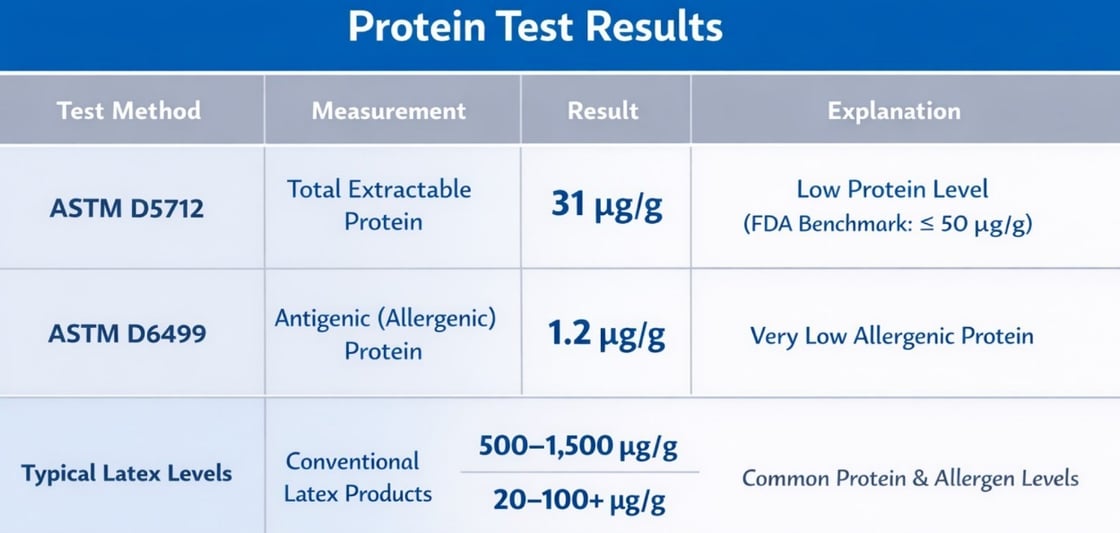
The test results above are reported as 1.2 µg/g and 31 µg/g, which describe how much of a substance is present by weight. These same values can also be expressed as parts per million (ppm) — a more intuitive way to understand very small amounts.
Because 1 µg/g is equal to 1 ppm by weight, these results translate directly to 1.2 ppm and 31 ppm. To help put those numbers into perspective, let’s relate them to time and volume so you can appreciate what “1 part per million” looks like in everyday terms.
If you think of one million parts as one million seconds, that equals about 11.6 days. On that scale, 31 ppm is like 31 seconds in 11.6 days, and 1.2 ppm is just over one second.
Alternatively, think of a full bathtub holding about 300 liters (80 gallons) of water. In that much water, 31 ppm is like 31 drops, and 1.2 ppm is only a little more than one drop.
Compared with typical natural rubber latex products, the amounts measured here are extremely small, making allergic reactions extremely unlikely for people without a known latex allergy.
Independent testing shows that YULASTIC fibers contain very low levels of latex protein compared with conventional natural rubber materials. These results reflect the effectiveness of the YULEX® PURE latex purification process and provide clear, transparent data about what is—and is not—present in YULASTIC fibers. While no natural rubber latex can be considered entirely risk-free for every individual, measuring protein levels allows the conversation to focus on meaningful reduction rather than assumptions. Taken together, these findings help position YULASTIC as a biobased, biodegradable, elastic fiber designed with a higher standard for protein reduction, supporting more informed choices for brands, manufacturers, and consumers.
Prescott SL, et al. World Allergy Organization Journal. 2013;6(1):21.
Gupta RS, et al. JAMA Network Open. 2019;2(1):e185630.
Centers for Disease Control and Prevention (CDC). FastStats: Allergies. National Center for Health Statistics.
Warren CM, et al. Current Allergy and Asthma Reports. 2020;20:6.
Turjanmaa K, et al. Allergy. 2002;57(6):493–503. (ScienceDirect review)
ASTM D5712 and ASTM D6499 tests performed at accredited LEAP Testing Service, http://www.guthrie.org/LEAP