In Rubber Chronicle 19, we showed that switching to natural rubber can dramatically reduce the CO2e emissions between 87- 95% compared to fossil‑based synthetic rubbers such as neoprene, geoprene, and SBR.
The underlying reason was simple: feedstock origin matters. That comparison was made on a cradle‑to‑gate basis. This cradle-to-gate analysis captures emissions from raw‑material production through material manufacturing but excludes downstream use and end‑of‑life (aka cradle-to grave).
This Rubber Chronicle applies the same lens to YULASTIC and elastane (spandex) filaments by doing a simlar crade-to-gate analysis of the base polymer that makes these products.
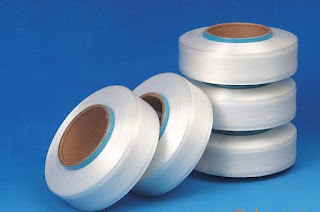
Elastane is a segmented polyurethane–urea elastomer. Unlike natural rubber, which enters the system already as a finished polymer, elastane must be synthesized from multiple monomers- that together form a single polymer backbone.
In brief, elastane is assembled from different alternating chemical segments: The soft segment adds stretch, and the hard segment adds strength.
In contrast, natural rubber is one continuous polymeric backbone structure composed of only carbon and hydrogen which performs essentially the same function.
The largest mass fraction of elastane is the soft segment derived from polyether polyols. These materials account for approximately 60–70 wt% of the polymer and provide elasticity and stretch. ISOPA* and PlasticsEurope eco‑profiles report cradle‑to‑gate emissions of approximately 2.9 kg CO₂e per kilogram of polyether polyol.
The hard segment is formed through the reaction of aromatic diisocyanates- Toluene Diisocyanate (TDI) and Methylene Diphenyl Diisocyanate (MDI)- with polyether polyols and chain extenders. Diisocyanates typically represent approximately 25–40 wt% of the polymer backbone and have cradle‑to‑gate emission factors in the range of roughly 2.7–3.1 kg CO₂e per kilogram.
Finally, small quantities of diamine chain extenders (typically 1–5 wt%) are used to form urea linkages within the hard segments. While these diamines are also fossil‑derived, their low mass fraction means their contribution to total raw‑material CO₂e is minor compared with the polyols and diisocyanates.
Because these inputs are present in different proportions, their climate impacts must be weighted by mass.
*ISOPA eco-profiles are based on aggregated, multi-producer industry data and developed under ISO-compliant life-cycle assessment standards with independent critical review, making them a widely accepted reference for cradle-to-gate emissions of polyurethane raw materials.
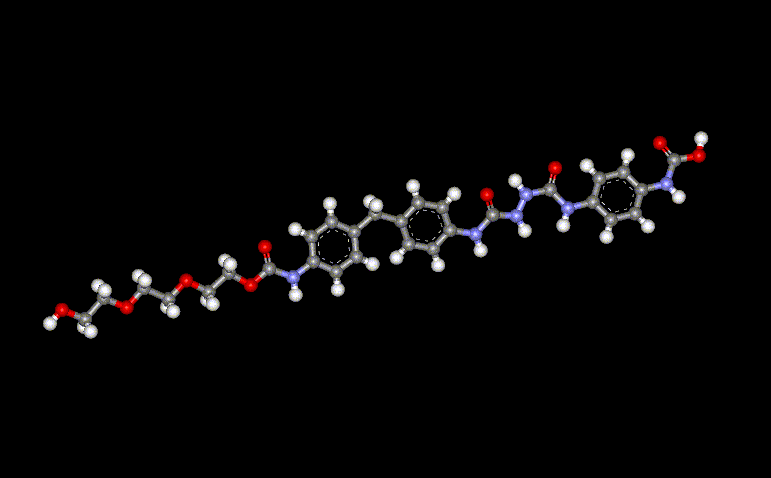
Elastane is assembled from different alternating soft and hard segments:
First, the largest mass fraction of elastane is the soft segment derived frompolyether polyols. These materials account for approximately 60–70 wt% of the polymer and provide elasticity and stretch. The cradle‑to‑gate emissions of approximately 2.9 kg CO₂e per kilogram of polyether polyol.
Secondly, TDI & MDI are Diisocyanates and represent ~25–40 wt% of the polymer and have cradle‑to‑gate emission in the range of ~2.7–3.1 kg CO₂e per kilogram.
Thirdly, chain extenders make up ~1–5 wt% and are used to connect the segments. Their contribution to total raw‑material CO₂e is minor compared with the polyols and diisocyanates.
YULASTIC natural rubber filaments are made from long-established, certified, deforestation-free, natural rubber latex that is tapped & harvested as an already‑formed polymer (cis‑1,4‑polyisoprene). Jawjit et al. (2010) reportcradle‑to‑gate emissions of approximately 0.54 kg CO₂e per kilogram of concentrated natural rubber latex from long-established plantations.
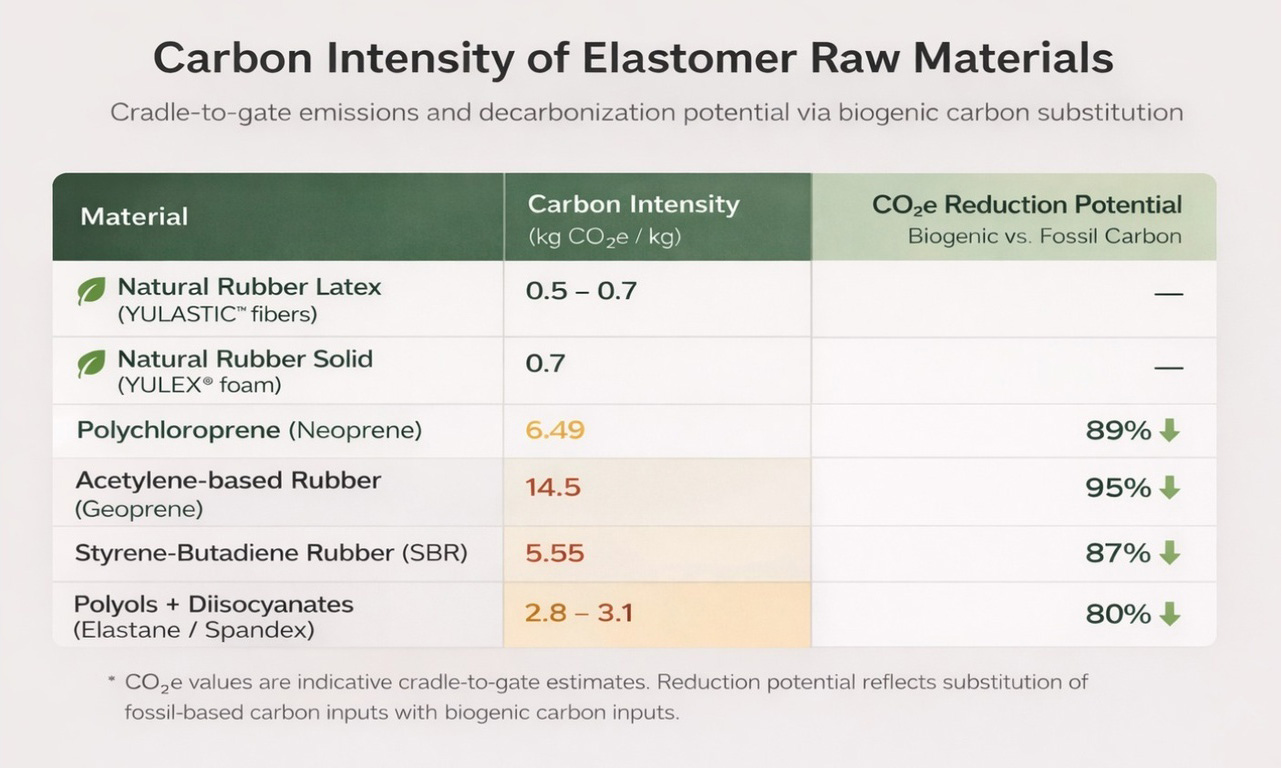
In conclusion, YULASTIC™ filaments made from certified natural rubber latex achieve an ~80% reduction in CO₂e emissions versus elastane (spandex), underscoring YULASTIC filaments potential as a lower-carbon alternative for stretch applications.
The Future of Stretch is Natural